
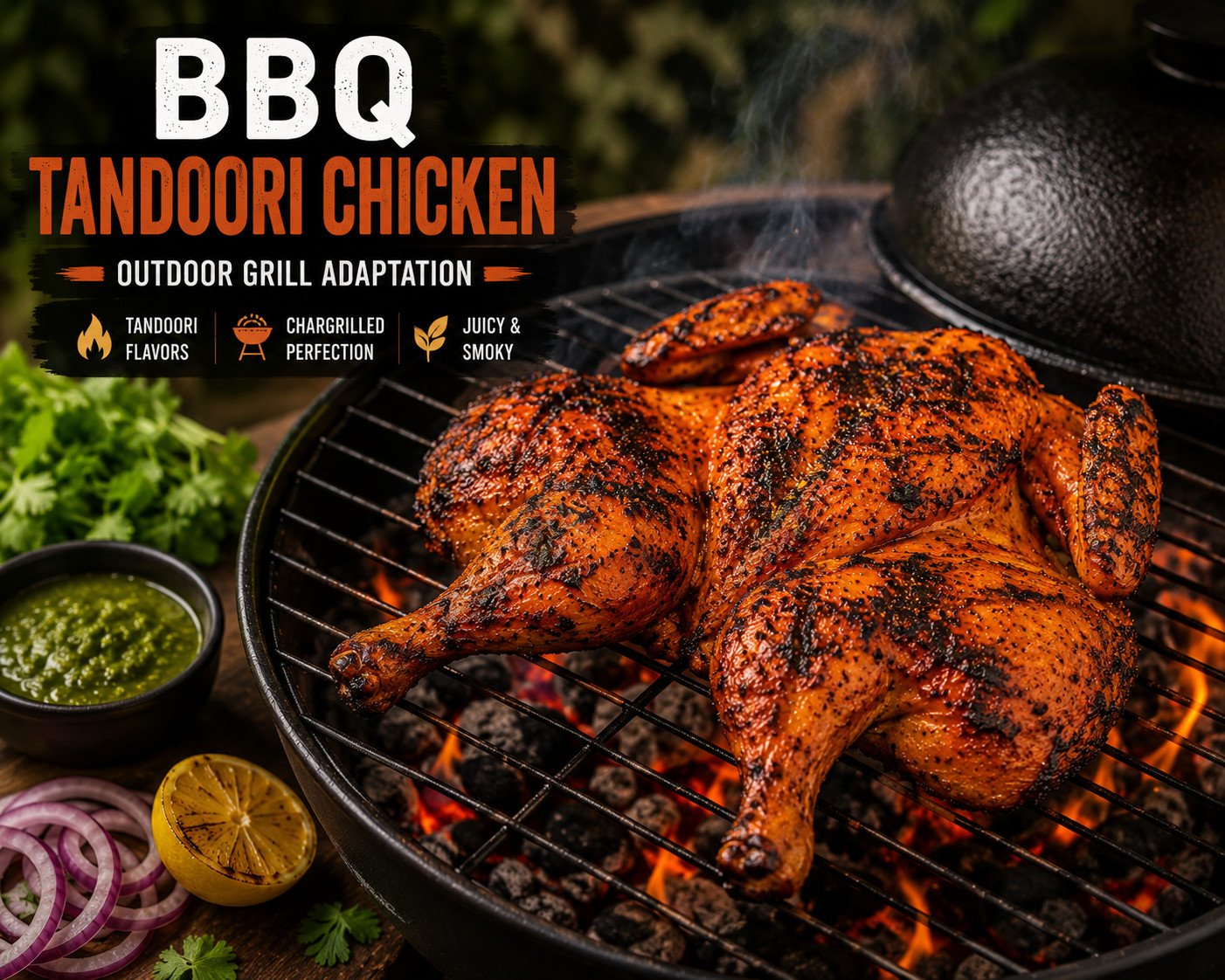
Not everyone has a clay tandoor in their backyard, and this guide exists for exactly that audience — anyone who wants to bring the Kashmiri marinade, the deep char, and the smoky flavour of tandoori chicken to a standard charcoal or gas BBQ grill. The marinade and prep work are identical to our classic clay oven recipe; what changes is the cooking method itself, adapted specifically for the realities of grill cooking — primarily one-directional heat, lower sustained temperatures than a tandoor, and the need to manage flare-ups from a marinade that drips fat and oil onto open flame.
What a Grill Can — and Can’t — Replicate From a Clay Oven
It’s worth being upfront about the gap between this method and true clay oven tandoori chicken, rather than overselling a grill as a perfect substitute. A clay tandoor delivers heat from all directions simultaneously through its cylindrical chamber, reaching 800 to 900 degrees Fahrenheit and holding that heat steadily against the clay walls. A grill, even a high-quality one, cooks primarily from below, tops out at meaningfully lower sustained temperatures, and loses heat readily every time the lid opens.
What a well-managed grill setup can replicate reasonably well: a properly charred, deeply coloured marinade crust, genuine smokiness (arguably even more pronounced than a gas-fired tandoor, if you’re using charcoal and wood chips), and a satisfying overall result that holds up well against any backyard chicken dish. What it can’t fully replicate: the perfectly even, all-directional char of true clay oven cooking, and the specific flavour the clay itself imparts through extended use and curing.
This isn’t a lesser recipe — it’s a genuinely good one, adapted honestly for equipment most people already have rather than pretending a grill is something it isn’t.
The Two-Zone Fire — The Technique That Makes This Work
The single most important grilling technique for this recipe is the two-zone fire: arranging your heat source so one side of the grill runs hot (direct heat) and the other side stays cooler (indirect heat), rather than spreading coals evenly across the entire grill bed.
Why Even Heat Distribution Fails Here
Chicken leg quarters need 25 to 35 minutes to cook through fully. If you cook that entire time directly over high heat — which is what an evenly spread fire forces you into — the marinade crust burns and blackens excessively long before the interior near the bone reaches a safe temperature. This is the single most common reason home-grilled tandoori chicken disappoints: a burnt, bitter exterior wrapped around an undercooked centre.
Setting Up the Zones
For charcoal, bank all the coals to one side of the grill, leaving the other side completely empty. For gas grills, light only the burners on one side, leaving the other side off. This creates a hot direct-heat zone and a cooler indirect-heat zone within the same grill, letting you move food between them as needed during the cook.
Method — Step by Step
Step 1 — Marinate (Identical to the Clay Oven Method)
Score each leg quarter with deep slits, first-marinate with lemon juice and salt for 30 minutes, then apply the full Kashmiri marinade as described in our classic recipe. Refrigerate 6 to 12 hours, ideally overnight.
Step 2 — Set Up the Two-Zone Fire
Arrange charcoal on one side only, or light half the burners on a gas grill. If using charcoal, add soaked wood chips directly to the coals for extra smoke. Allow the grill to reach temperature — charcoal should be covered with grey ash, gas grills should read approximately 450 to 500 degrees Fahrenheit on the direct side.
Step 3 — Sear Over Direct Heat
Place chicken skin-side down over the direct heat side for 3 to 4 minutes per side, watching closely — marinade sugars and fats can flare up quickly over open flame, so keep a close eye and move pieces if flare-ups become excessive.
Step 4 — Finish Over Indirect Heat
Move chicken to the indirect side, cover the grill, and cook 25 to 30 minutes, turning occasionally and basting with melted butter, until internal temperature reaches 75 degrees Celsius at the thickest point away from the bone.
Step 5 — Rest and Serve
Rest 5 minutes before serving. Sprinkle chaat masala, serve with lemon wedges and mint chutney.
Managing Flare-Ups
The yogurt and oil in a tandoori marinade can drip and cause more flare-ups than a plain, unmarinated piece of chicken would on the same grill. Keep a spray bottle of water nearby during the direct-heat searing stage specifically — a quick mist can knock down a flare-up without significantly cooling the grill or interrupting the cook. Avoid this once chicken has moved to the indirect side, where flare-ups are far less likely and water isn’t needed.
Equipment Notes for Grilled Tandoori Chicken
Grill Thermometer
An accurate read on grill temperature matters more for this recipe than for simpler grilling tasks, given the precision the two-zone technique requires. A built-in grill thermometer is a reasonable starting point, though a separate instant-read probe thermometer for checking the chicken’s internal temperature directly is essential — built-in grill thermometers measure ambient air temperature inside the lid, not the meat itself, and the two can diverge meaningfully.
Wood Chip Selection
For charcoal grills, soaking wood chips in water for 30 minutes before adding them to the coals slows their burn rate, producing steady smoke over a longer period rather than a quick burst that’s gone before the chicken has absorbed much flavour. Fruit woods like apple or cherry produce a milder smoke that complements the Kashmiri spice blend without overwhelming it; hickory and mesquite are more assertive and can compete with the marinade’s own flavour profile if used too generously.
Grill Grate Preparation
Oil the grates lightly before placing the marinated chicken, even though the marinade itself contains oil — this extra step further reduces the risk of skin sticking and tearing during the initial direct-heat sear, when the marinade crust is still setting and most vulnerable to damage from contact with the grate.
Adjusting for Different Weather Conditions
Cold Weather Grilling
Outdoor temperatures below roughly 10 degrees Celsius slow a grill’s heat-up time and can make maintaining consistent indirect-zone temperature more difficult, since the grill loses heat to the surrounding cold air more readily. Allow extra preheat time and check internal chicken temperature slightly more frequently than usual, since cold ambient conditions can extend the indirect cooking phase beyond the 25 to 30 minute range given here.
Windy Conditions
Strong wind can push flames and heat unevenly across the grill surface, undermining the controlled two-zone separation this recipe depends on. If grilling in noticeably windy conditions, position the grill with its lid opening away from the wind direction where possible, and monitor the direct-heat zone more closely for uneven flare-ups.
Frequently Asked Questions — BBQ Tandoori Chicken
Can a backyard grill really replicate clay oven tandoori chicken?
Not exactly, but reasonably close. A grill cooks mostly from one direction and runs cooler than a tandoor’s 800-900°F, losing some all-directional char and clay smokiness. The two-zone fire with a covered grill narrows that gap considerably.
Why use a two-zone fire instead of cooking directly over the coals the whole time?
Leg quarters take 25-35 minutes to cook through. Direct heat the entire time would burn the exterior before the interior near the bone reached safe temperature. Two-zone lets you sear for char then finish gently.
Should I use charcoal or gas for BBQ tandoori chicken?
Charcoal produces more smoke flavour, narrowing the gap with clay oven smokiness. Gas offers more consistent temperature control. Either works; charcoal with wood chips gets marginally closer to a tandoor’s flavour.
Do I need to adjust the marinade for grilling versus a clay oven?
No — the same Kashmiri marinade and double-marination technique works directly. Only the cooking method changes; the marinade doesn’t need adjustment.
How do I get smoke flavour on a gas grill?
Wrap soaked wood chips in foil with holes poked through, place over a lit burner on the indirect side. The chips smoulder and produce smoke during the longer indirect cooking phase.
What internal temperature should grilled tandoori chicken reach?
75 degrees Celsius at the thickest part away from the bone — the same safe target as the clay oven version. Juices should also run completely clear near the bone.