
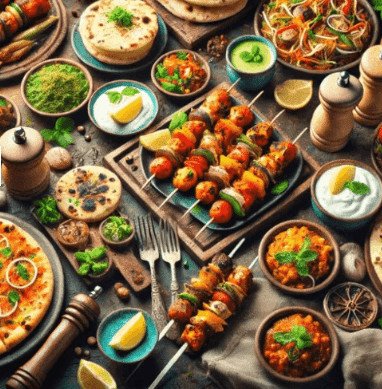
Eid celebrations centre heavily around shared meals, and a clay tandoor — capable of producing multiple proteins, breads, and vegetable dishes across a single extended cooking session — fits naturally into the scale and spirit of an Eid feast. This guide focuses specifically on the planning and sequencing side of putting together a tandoor-based Eid spread: how far ahead to prepare, how many dishes to plan, what order to cook them in, and which recipes across this site work particularly well for a celebratory gathering.
Building Your Preparation Timeline
1 to 2 Days Ahead
Shopping for proteins, produce, and any specialty spices not already on hand. This is also a good window for preparing sauces or chutneys that hold well refrigerated, like mint chutney or a tamarind-date chutney, freeing up time closer to the feast itself.
The Evening Before
Marinate any protein requiring overnight marination — bone-in chicken, lamb seekh kebab mixture, and most traditional Kashmiri-marinated dishes fall into this category. This is the single most important advance step, since rushing marination on the day itself measurably compromises the final result for these specific dishes.
The Day of the Feast
Bread doughs should be made fresh — naan and roti both lose meaningful quality if prepared too far ahead, and the wall-baking technique works best with freshly rolled dough rather than dough that’s been resting for many hours beyond its intended rise time. Vegetable pre-treatment (blanching, salting, par-boiling, depending on the specific dish) also happens same-day, shortly before the cooking session itself begins.
Scaling the Menu to Your Gathering
For a gathering in the 10 to 15 guest range, a reasonable target is 3 to 4 main protein dishes, 2 bread varieties, and at least one vegetarian option — enough genuine variety to feel like a proper feast without overextending what’s realistically achievable in a single cooking session, particularly for a household managing the meal without additional kitchen help. Larger gatherings generally call for increasing batch sizes of the same core dishes rather than adding many more distinct items, which keeps the cooking sequence manageable even as guest count grows.
It’s worth resisting the temptation to maximize variety purely for its own sake. Three or four dishes executed with full attention and care consistently leave a stronger impression than six dishes each receiving divided focus — a principle worth keeping in mind when the instinct is to add “just one more” recipe to an already ambitious menu.
Sequencing the Cooking Session
The most efficient approach follows the tandoor’s natural heat curve rather than fighting against it. Start with vegetables and paneer at the cooler 650 to 700 degree range while the oven is still climbing toward full temperature. Move to bone-in meats — the classic tandoori chicken and lamb seekh kebabs — once the oven reaches its peak 800 to 900 degrees. Work naan and roti in throughout at their own 600 to 650 degree range, fitting them into natural gaps between meat batches rather than treating bread as an afterthought tacked onto the very end.
Recommended Dishes for an Eid Spread
Centrepiece Proteins
Classic Tandoori Chicken for its dramatic whole-piece presentation, and Lamb Seekh Kebabs for richer, more indulgent flavour — together these cover the two most universally appreciated tandoori meat formats.
Vegetarian Option
Tandoori Paneer Tikka remains the most broadly appealing vegetarian choice, ensuring guests with dietary restrictions or vegetarian preferences still get a genuine tandoor-cooked, charred dish rather than a separately prepared afterthought.
Bread
Pair Garlic Naan with at least one alternative — Tandoori Roti for a simpler, everyday option, or Chilli Coriander Naan if your guest list skews toward spice-tolerant palates.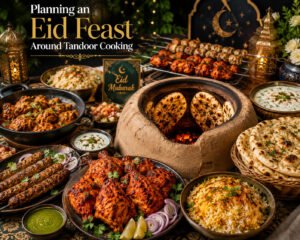
Keeping Food Warm Through a Long Session
With multiple dishes cooking across an extended session, some food inevitably finishes before others. Loosely covering finished dishes with foil and holding them in a warm (not hot) oven or an insulated serving container works reasonably well for a limited window, though quality does decline the longer anything sits before serving. Where possible, sequencing the cooking schedule so the final dishes finish close to actual serving time — rather than maximizing how long earlier dishes can hold — generally produces a better overall result across the full spread.
Why Tandoor Cooking Suits Eid Celebrations
Eid al-Fitr and Eid al-Adha both centre around community, generosity, and shared abundance after a period of reflection and, for Eid al-Fitr specifically, the conclusion of Ramadan fasting. A tandoor’s capacity for producing substantial quantities of genuinely impressive, deeply flavoured food across a single extended cooking session aligns naturally with the spirit of hospitality central to these celebrations — guests gathering, food shared generously, and a sense of occasion that matches the significance of the day itself.
The clay tandoor also has its own long history within Muslim culinary traditions across South Asia, the Middle East, and Central Asia, making it a particularly fitting choice for Eid specifically rather than simply a convenient high-capacity cooking method. Many families have their own established Eid tandoor traditions, whether centred on a particular protein, a specific bread, or a sequence of dishes passed down through generations — traditions this guide’s general planning framework is meant to support rather than replace.
Rounding Out the Spread — Accompaniments and Extras
Chutneys and Sauces
Mint chutney and a tangy tamarind-date chutney both work as universal accompaniments across nearly every protein and bread on the menu, and both can be prepared well ahead of the feast itself, freeing up same-day attention for the time-sensitive tandoor cooking. A simple raita also provides a cooling counterpoint to the richer, more heavily spiced main dishes.
Rice as a Supplementary Option
For guests who prefer rice alongside or instead of bread, a simple whole-spice basmati rice rounds out the spread without requiring significant additional tandoor time, since rice cooks separately on the stovetop while the oven handles proteins and bread.
Salads and Fresh Elements
A simple onion salad with lime, or a fresh cucumber and tomato mix, adds textural and flavour contrast against the richness of multiple tandoor-cooked dishes, and requires no cooking time at all — a practical addition when the tandoor itself is already running at capacity throughout the cooking session.
Dessert
While most Eid desserts are traditionally prepared separately from the tandoor, the more adventurous host might consider incorporating a tandoor-baked dessert as a genuinely memorable closing note to the meal, leveraging the oven one final time after the savoury cooking session has wrapped up, for guests who appreciate an unexpected final flourish to round out the celebration.
Practical Tips for Managing a Large Gathering
Recruit Help Where Possible
Even with careful planning, a full Eid spread built around tandoor cooking represents significant work for a single cook. Delegating non-tandoor tasks — chutney preparation, salad assembly, table setting, and serving — to family members or guests who arrive early frees up the primary cook’s attention for the parts of the meal that genuinely require focused, undivided attention: timing the tandoor sequence correctly.
Communicate Timing to Guests
Letting guests know roughly when food will be ready, rather than an exact time that tandoor cooking’s inherent variability might not allow you to hit precisely, manages expectations more realistically than a fixed serving time that puts pressure on a process that doesn’t always run exactly to schedule.
Shopping and Budget Planning
Beyond the cooking logistics, a few practical shopping considerations help an Eid tandoor feast come together smoothly without last-minute scrambling for ingredients.
Buy Proteins in Advance When Possible
Since most centrepiece proteins benefit from overnight marination, purchasing chicken and lamb a day or two ahead — rather than the same day — builds in a buffer against any sourcing difficulties and ensures the marination timeline isn’t compromised by a delayed grocery trip on an already busy preparation day.
Spice Stock Check
Given how many dishes across a typical Eid spread share core spices — Kashmiri chilli, cumin, garam masala, ginger-garlic paste — checking your spice stock well ahead of the feast, rather than discovering a shortage mid-preparation, avoids a stressful last-minute store run during an already demanding cooking day. Buying slightly more than you think you’ll need for these shared, frequently used spices is generally a safer approach than buying exact quantities for each individual recipe.
Consider Portion Planning
Estimating roughly 200 to 250 grams of total protein per guest across all dishes combined, adjusted up or down based on how many other substantial items (rice, multiple breads, a hearty vegetarian dish) round out the spread, gives a reasonable starting point for total quantity planning without either running short or over-preparing significantly beyond what the gathering will actually consume.
Frequently Asked Questions — Eid Feast Tandoori Dishes
How far in advance should I start preparing for an Eid tandoor feast?
Marinate proteins the evening before for overnight-marinade dishes. Make breads fresh the day of. Shopping and chutney prep can happen 1-2 days ahead.
How many tandoor dishes should I plan for a large Eid gathering?
For 10-15 guests, 3-4 main proteins plus 2 breads and at least one vegetarian option provides good variety without overextending preparation. Scale via batch size, not more distinct dishes.
What order should dishes be cooked in for a large feast?
Vegetables and paneer first at 650-700°F as the oven climbs, then bone-in meats at 800-900°F at peak heat, with naan and roti worked in throughout at 600-650°F.
Should I prioritize variety or doing fewer dishes really well?
Fewer dishes executed well outperforms more dishes each receiving less attention, particularly for a single-cook household managing the entire feast.
What vegetarian options work well for an Eid spread that includes non-Muslim or vegetarian guests?
Tandoori paneer tikka is the most universally appreciated option. Tandoori cauliflower and aloo tikka add variety without compromising the tandoor-cooked character of the meal.
How do I keep food warm while finishing other dishes during a long cooking session?
Loosely cover with foil in a warm oven or insulated container for a limited window. Staggering the schedule so final dishes finish near serving time works better than maximizing hold time.