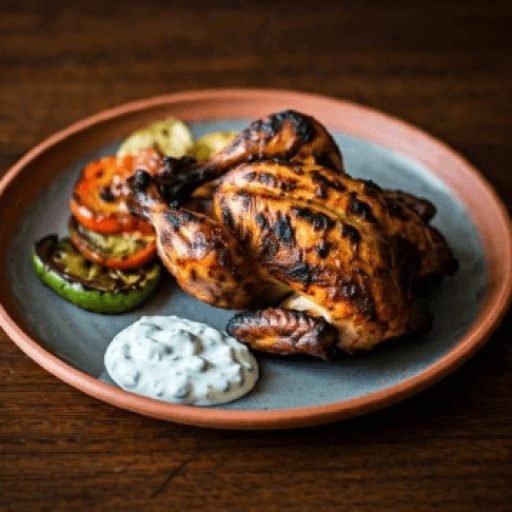
Cornish hen brings the same Kashmiri marinade and clay oven technique used throughout this site’s chicken recipes to a smaller, whole-bird format — each guest receiving their own individually portioned, dramatically charred small bird rather than a shared leg quarter. It’s a striking choice for a more formal meal or special occasion, where the presentation itself contributes meaningfully to the dining experience.
Prep: 25 minutes plus 6 to 12 hours marination | Cook: 18 to 22 minutes | Serves: 2 (1 hen each, or split for lighter portions)
Why Cornish Hen Offers Something Leg Quarters Can’t
Classic tandoori chicken’s bone-in leg quarters deliver excellent flavour and the satisfying char this site’s recipes are built around, but they’re inherently a shared or portioned cut — each guest receives a piece of a larger bird rather than their own complete one. Cornish hen flips this entirely: each diner gets an individually portioned whole bird, small enough to cook in roughly the same timeframe as a leg quarter but visually distinct and considerably more dramatic on the plate.
This makes Cornish hen a natural choice for situations where presentation carries real weight — a dinner party, a special-occasion meal, or any context where the visual impact of an individually plated whole bird adds something a shared cut of chicken doesn’t.
The Spatchcocking Technique — Why It’s Essential Here
Cooking a Cornish hen whole and round in a tandoor presents a real problem: the breast, being thinner and more exposed, finishes cooking well before the denser thigh meat does, leading to a choice between dry breast or undercooked thigh. Spatchcocking — cutting out the backbone and pressing the bird flat — solves this directly by bringing the whole bird to a more uniform thickness, comparable to a leg quarter, allowing breast and thigh to finish at closer to the same time.
The flattened shape also makes the hen considerably easier to secure on a skewer or lay flat on a mesh tray, and exposes more surface area to the tandoor’s radiant heat, both of which work in this recipe’s favour given the relatively short 18 to 22 minute cook time.
Method — Step by Step
Step 1 — Spatchcock the Hens
Using kitchen shears, cut along both sides of the backbone and remove it entirely. Flip the hen breast-side up and press firmly on the breastbone with the heel of your hand until you hear or feel it crack and the bird lies flat. Repeat for the second hen.
Step 2 — First Marinade
Rub the flattened hens thoroughly with lemon juice and salt, working it into any exposed areas from the spatchcocking cuts. Refrigerate 30 minutes, then pat completely dry.
Step 3 — Apply the Kashmiri Marinade
Whisk hung curd, ginger-garlic paste, and mustard oil until smooth. Add all dry spices and salt. Coat the hens thoroughly, working the marinade under the skin where possible for deeper flavour penetration. Refrigerate 6 to 12 hours.
Step 4 — Preheat and Skewer
Preheat your Tandoor Morni clay oven to 800 to 850 degrees Fahrenheit. Secure each flattened hen onto a sturdy skewer, or place on a mesh tray if your oven setup favours that approach for flatter, larger pieces.
Step 5 — Cook
Cook 18 to 22 minutes, rotating once or twice, basting with melted butter at the halfway point. The hen is done when internal temperature at the thickest part of the thigh reaches 75 degrees Celsius.
Step 6 — Rest and Serve
Rest 5 minutes before serving. Sprinkle chaat masala, serve with lemon wedges — either one hen per person for a hearty portion, or split between two for a lighter serving alongside other dishes.
Sourcing Cornish Hens
Most well-stocked grocery stores carry Cornish hens in the poultry section, though they’re more commonly found frozen than fresh given their less frequent purchase pattern compared to standard chicken cuts. Specialty butchers can usually source them on request, and demand tends to rise around holidays, when individually portioned poultry becomes more popular for smaller gatherings or formal dinners. If buying frozen, plan for a full day of refrigerator thawing before beginning the marination process.
Presentation and Plating
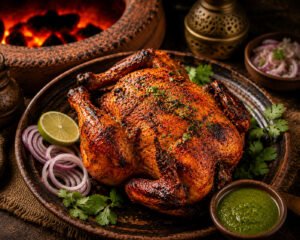
Given that Cornish hen’s main advantage over leg quarters is presentation, it’s worth giving some thought to how you plate the finished dish. A whole hen, browned and charred from the tandoor, sits naturally as the centrepiece of an individual plate, needing relatively little additional garnish to look genuinely impressive — a scatter of fresh coriander, a wedge of lemon, and perhaps a small side of raita or a vegetable accompaniment is usually sufficient.
For a more elaborate presentation, serving the hen on a bed of saffron or whole-spice basmati rice elevates the visual impact further, letting the bird’s golden-brown, deeply charred exterior contrast against the rice underneath. This pairing also works practically, since both elements can be timed to finish close together within a single cooking session.
Scaling for a Dinner Party
This recipe scales straightforwardly for a larger gathering — simply multiply the marinade ingredients and hen count proportionally. The main practical consideration at scale is tandoor capacity: most home ovens comfortably accommodate 2 to 4 spatchcocked hens per batch depending on chamber size, meaning a dinner party of 6 or more guests likely requires cooking in two sequential batches rather than one, with the first batch held warm, loosely covered, while the second finishes.
Marinating all hens together the evening before, regardless of how many batches the actual cooking requires, keeps preparation simple and ensures consistent flavour across the entire group rather than managing separate marinade batches for each cooking round.
Variations on Tandoori Cornish Hen
Hariyali Cornish Hen
Substituting a fresh coriander, mint, and green chilli marinade for the standard Kashmiri blend produces a vivid green version, following the same spatchcocking and cooking technique throughout.
Stuffed Cornish Hen
A small amount of spiced rice or a simple herb-and-butter mixture placed under the skin before marinating, rather than served alongside, adds an additional flavour dimension directly into the bird itself, though this requires slightly more careful handling during the marination and cooking stages to keep the stuffing in place.
Frequently Asked Questions — Tandoori Cornish Hen
Why choose Cornish hen over a standard leg quarter for tandoori chicken?
Cornish hen offers a dramatic, individually portioned whole-bird presentation leg quarters can’t replicate — each guest gets their own small whole bird, suiting formal or special-occasion meals where visual impact matters.
Why spatchcock the hen rather than cooking it whole and round?
Spatchcocking exposes more surface area, reduces cook time, eases skewering, and ensures more even cooking — a round whole bird cooks unevenly with the breast often finishing before the thigh.
How long does Cornish hen take to cook compared to chicken leg quarters?
Roughly similar, 18-22 minutes vs 18-25 minutes for leg quarters, since spatchcocking flattens the hen to a comparable uniform thickness despite being a whole bird.
Can I use the same marinade as classic tandoori chicken for Cornish hen?
Yes, the standard Kashmiri marinade works directly without modification. The differences are about cut and presentation, not marinade composition.
Where can I buy Cornish hens?
Most well-stocked grocery stores carry them, often frozen. Specialty butchers and warehouse stores are reliable sources, particularly around holidays.
Is one Cornish hen enough for one person, or should I plan for less than a full bird?
A whole hen, roughly 500-600 grams, works as a hearty single portion or can be split between two for a lighter serving — plan based on whether it’s the meal’s sole protein.
!