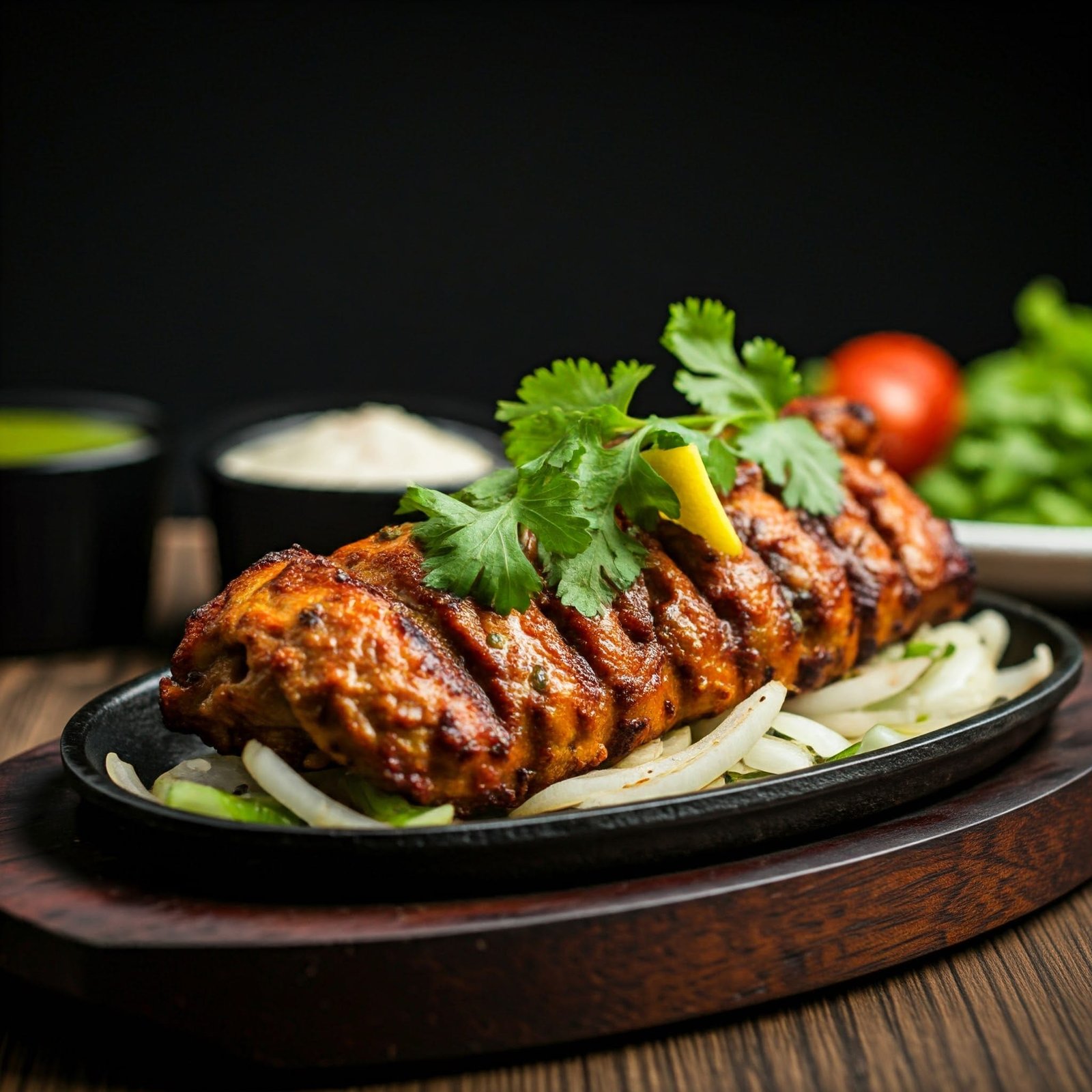
Lamb tikka is one of the most profitable and crowd-pleasing items a tandoor-equipped food truck can offer — deeply spiced, overnight-marinated lamb shoulder, charred in the extreme heat of a compact clay tandoor, producing a result that no flat grill can replicate. This guide covers the complete recipe alongside the operational considerations specific to food truck service: cut selection that survives high-heat cooking and slight timing variation, batch sequencing for continuous output, and the CS02 Food Truck Tandoor Oven’s specific operational characteristics.
Marinade: Overnight, minimum 6 hours | Cook: 12 to 15 minutes | Oven: CS02 Food Truck Tandoor Oven, 24 inches x 24 inches, NSF certified | Output: 12 to 20 portions per hour
Why Lamb Shoulder Outperforms Leg for Food Truck Tikka
This is the most consequential ingredient decision in the entire recipe. At home, with full attention on a single batch, lamb leg tikka produces a perfectly good result. On a food truck, where you’re simultaneously taking orders, handling payments, and managing several preparations at once, a skewer of leg tikka that stays in the oven 17 minutes instead of 13 comes out dry and tough. Shoulder, with significantly more intramuscular fat, stays juicy at 17 minutes because that fat continues rendering and basting the meat throughout the extended cook — far more forgiving for the realities of busy service.
Shoulder is also typically less expensive than leg in most wholesale markets, which matters directly to food truck margins. Cut into even 4 centimetre cubes — uniformity is critical, since larger pieces will be undercooked when smaller pieces are done, and smaller pieces will be dry by the time larger pieces finish.
The Marinade — Scaled for Food Truck Production
Ingredients for 2 Kilograms Lamb (8 to 10 Portions)
- 200 grams hung curd
- 3 tablespoons ginger-garlic paste
- 3 tablespoons mustard oil
- 3 teaspoons Kashmiri red chilli powder
- 2 teaspoons cumin powder
- 2 teaspoons coriander powder
- 1 teaspoon garam masala
- 1 teaspoon turmeric
- half teaspoon dried fenugreek leaves (kasuri methi)
- 2 tablespoons dry-roasted besan
- juice of 1 lemon
- 20 grams salt
Scaling for Weekly Production
For busy operations, batch-marinate in 5 to 10 kilogram quantities, scaling every ingredient linearly. Marinated lamb holds well refrigerated for up to 36 hours, allowing Sunday’s production to be prepared Saturday evening for Monday service. Pre-skewered portions hold refrigerated for up to 4 hours without quality loss.
CS02 Operational Notes for Lamb Tikka
The CS02 Food Truck Tandoor Oven’s compact 24-inch chamber heats to working temperature faster than the larger CH02 or T02 commercial models — typically 20 to 25 minutes on high to reach 700 degrees. The smaller chamber also responds more quickly to the cooling effect of cold marinated protein entering the oven. Expect a 50 to 80 degree temperature drop in the first minute after loading a cold batch on a cool day; this is normal and shouldn’t prompt increasing the flame, since overcorrecting risks an overshoot spike once the meat warms through.
The CS02 accommodates 4 to 6 lamb skewers simultaneously depending on diameter and piece size. At 200 grams per skewer and 15 minutes per batch, continuous service yields approximately 15 to 20 portions per hour — sufficient for a single-item food truck at moderate volume, or as one item within a broader menu.
Method — Step by Step
Day Before Service
Cut lamb shoulder into 4 centimetre cubes. Apply first marinade (lemon juice and salt), refrigerate 30 minutes. Mix the full Kashmiri marinade, combine with lamb, refrigerate overnight.
Morning Mise en Place
Thread marinated lamb onto flat metal skewers during morning preparation. Hold refrigerated in inserts until service.
At Service
Preheat CS02 to 700 to 750 degrees Fahrenheit. Pull pre-skewered lamb 20 to 30 minutes before the first batch to take off the chill. Lower into the oven, cook 12 to 15 minutes, rotating once. Check internal temperature: 72 degrees Celsius means safe and still juicy. Rest 2 to 3 minutes before sliding pieces to the serving vessel.
At the Pass
Sprinkle chaat masala, squeeze fresh lemon, add raw onion and mint chutney. Serve in a kraft box for street food presentation, or in a wrap with garlic naan or roti from the same tandoor — the highest-value format a food truck tandoor can produce.
Food Truck Service Tips
Batch Timing at High Volume
Load as soon as the previous skewer is removed. Don’t wait for orders — cook continuously and hold finished tikka on the oven lip at reduced flame for a maximum of 5 to 7 minutes before quality drops noticeably.
Visual Quality Benchmark
Train staff to a consistent visual standard before service: deep orange-red Kashmiri colour on flat surfaces, charred black at edges and corners, firm-set crust with no wet marinade visible, and no pink when a piece is halved.
Chaat Masala and Lemon Timing
Apply both immediately before serving, never during cooking. Chaat masala applied early loses its brightness; lemon juice applied before cooking accelerates surface drying.
Cost and Profitability Considerations
Lamb tikka commands a premium price point on most food truck and catering menus relative to chicken-based items, which makes understanding its cost structure worthwhile for operators planning a menu around it.
Ingredient Cost Per Portion
At roughly 200 grams of raw lamb shoulder per portion before cooking loss, and accounting for typical wholesale lamb shoulder pricing, the raw protein cost per portion is generally higher than chicken thigh but lower than premium cuts like rack of lamb — positioning lamb tikka as a mid-to-premium menu item that can support a meaningfully higher price point than chicken-based competitors on the same menu.
The CS02’s Role in Unit Economics
The CS02 Food Truck Tandoor Oven represents the entry point into commercial clay tandoor equipment, and its relatively compact footprint and moderate fuel consumption compared to larger commercial models make it well suited to the space and power constraints typical of a food truck build-out. Operators evaluating whether to add a tandoor to an existing truck, versus building a menu around one from the start, should weigh the CS02’s output capacity (12 to 20 portions per hour for lamb tikka specifically) against expected peak-hour demand for their specific market and pitch location.
Menu Positioning
Lamb tikka pairs naturally with the wrap format described above, which increases average transaction value by combining the protein with bread from the same oven in a single higher-priced menu item, rather than selling tikka and naan as separate lower-margin components.
Additional Food Truck Considerations
Beyond the recipe and oven operation itself, a few practical factors specific to food truck service are worth planning for before adding lamb tikka to a mobile menu.
Gas Supply and Ventilation
Confirm the CS02’s gas supply requirements fit within your truck’s existing setup before committing to a tandoor-based menu — propane cylinder capacity and refill logistics differ meaningfully from a fixed natural gas line, and most mobile installations run on propane given the obvious lack of a permanent gas connection at varying pitch locations.
Local Health Department Requirements
Certification requirements for commercial clay tandoor equipment can vary by jurisdiction, and confirming NSF/ANSI 4 compliance documentation is available and current before a health inspection saves considerable hassle on opening day or during routine inspections.
Frequently Asked Questions — Lamb Tikka for Food Trucks
Why lamb shoulder rather than leg for food truck service?
Higher intramuscular fat keeps tikka juicy even if slightly overcooked during busy service — leaner leg would dry out and toughen. Shoulder is also typically less expensive, helping food truck margins.
How many portions can the CS02 produce per hour?
4 to 6 skewers per batch, 3 to 4 batches per hour, yielding 12 to 20 portions per hour depending on portion size and how tightly batches are staged.
Why does this recipe call for overnight marination specifically?
Lamb shoulder’s connective tissue softens over many hours and spice penetrates deeper into the dense muscle. Minimum 6 hours works; overnight produces noticeably better flavour and tenderness.
How should I stage production for a busy service period?
Pre-skewer during morning prep, hold refrigerated, load continuously rather than waiting for orders — keeps the CS02 temperature more consistent than intermittent loading.
Can I use the same marinade for chicken tikka on the same truck?
Yes, the Kashmiri base works for both. Lamb needs overnight; chicken needs only 4 to 6 hours. Marinate both the evening before, staggering as needed.
How do I keep lamb tikka warm during a rush without it drying out?
Cook in small batches timed to demand rather than holding. If unavoidable, limit holding to 5-7 minutes on the oven lip at reduced heat, covered loosely.
Need Help? Order and Technical Support
Have questions or ready to place an order? Reach out to us via phone at +1(727) 251 6924 or email us at info@tandoormorni.com.
Need detailed instructions? Explore the Operation Manual for our CH & CS models to get started with your Tandoor oven today.
About Tandoor Morni
Tandoor Morni, in business since 1992, is a trusted name in premium Tandoori Clay Ovens, known for crafting high-quality traditional and commercial tandoors. With a commitment to excellence, Tandoor Morni offers a wide range of tandoors, including commercial, residential, catering, and copper models. Our tandoors are built with durable materials and designed for efficient heat distribution, ensuring authentic flavors and fast cooking. Each oven features customizable options like gas, wood fire, or charcoal compatibility, making them suitable for various cooking needs.